

Chad Boudreaux Interview | Mob Justice Author on Writing Thrillers with Real DOJ Experience
In this episode of Meet the Thriller Author, Alan Petersen interviews Chad Boudreaux, a former U.S. Department of Justice insider turned thriller novelist. If you’re searching for a Chad Boudreaux interview, insights into Mob Justice, or how real-world national security experience shapes fiction, this conversation delivers.
Boudreaux brings a unique background to the genre. Hired by the DOJ on the eve of 9/11, he launched his career in counterterrorism before moving on to the Department of Homeland Security as Deputy Chief of Staff. Today, he serves as chief legal officer of a Fortune 300 company—while writing high-stakes thrillers on the side.
His latest novel, Mob Justice: A Scavenger Hunt Thriller, takes readers into the modern Chicago mafia, blending organized crime with deeper, hidden power structures. The book follows Justice Department lawyer Blake Hudson as he navigates shifting loyalties and a dangerous criminal underworld. As Boudreaux explains in the interview, much of the realism comes from his firsthand experience: “75% of the things I write about I’ve lived in some form or fashion.”
In the interview, Boudreaux discusses his writing process, including his use of outlines, his goal of 100,000-word novels, and how his characters often take over the story midway through. He also shares how he balances writing with a demanding career—waking up early, writing consistently, and treating it as both discipline and therapy.
Connect with Chad Boudreaux
Latest Book
Chad Boudreaux Books

Show Notes and Transcript
Video
Episode Summary – Chad Boudreaux Interview
- [00:00] Introduction to Chad Boudreaux and his background in the U.S. Department of Justice and Homeland Security
- [01:30] His journey into writing and early inspiration from teachers and post-9/11 experiences
- [03:15] Writing timeline: first novel took 18 months over 20 years; now writing books in ~9 months
- [04:20] Overview of Mob Justice: A Scavenger Hunt Thriller and its modern Chicago mafia setting
- [05:45] Researching the Chicago Outfit and uncovering hidden details like underground tunnels
- [07:00] Who is Blake Hudson? Building a DOJ lawyer protagonist in high-stakes situations
- [09:00] Creating Enzo Renzi and the “consigliere” influence from The Godfather
- [12:40] Writing a series: evolving Blake Hudson and building a long-term story arc
- [15:00] Balancing realism and storytelling using real-world legal and national security experience
- [16:15] Research process: consulting FBI experts and ensuring authenticity
- [20:50] Fun research story: getting kicked out of Chicago City Hall while scouting locations
- [23:25] Writing process: outlining, 100K word targets, and characters taking over mid-book
- [25:15] Writing tools: keeping it simple with Microsoft Word
- [25:30] Writing routine: early mornings, daily consistency, and treating writing as therapy
- [27:30] Discipline vs. creativity: balancing a demanding executive career with fiction writing
- [28:45] Future plans: expanding the series and carving out a niche in DOJ-based thrillers
- [30:30] Advice for aspiring writers: persistence, humility, and improving your craft
Key Takeaways
- Real-world experience can elevate thrillers—but storytelling always comes first
- Consistency matters more than word count (5 words or 5,000—just keep writing)
- Outlining helps, but great characters will often take the story in new directions
- Research and expert input are critical for authenticity
- Writing can coexist with a demanding career through discipline and routine
- Success in writing comes from persistence and continuous improvement
Transcript
Heads Up:
This transcript was generated with the help of AI and only got a quick once-over from a human. So if you spot a typo or something that doesn’t make sense… let’s just blame the robots. 🤖
[00:00:04.990] – Alan Petersen
You are listening to Meet the Thriller Author, the podcast where I interview writers of mysteries, suspense, and thrillers. I’m your host, Alan Petersen, a fan and writer of the genre myself. In this episode, number 234, I’m joined by Chad Boudreaux. Chad brings a rare level of real-world experience to the thriller genre. He began his career at the United States Department of Justice on the eve of 9/11, launching into counterterrorism work. He later served at the Department of Homeland Security as a Deputy Chief of staff working on major policy, operational, and legal issues. Today he’s the chief legal officer for Fortune 300 company and America’s largest military shipbuilder. Now he’s channeling that insider experience into fiction with his latest thriller, Mob Justice: A Scavenger Hunt Thriller, out March 17th. In this book, the Justice Department lawyer Blake Hudson takes on the modern Chicago Mafia in a high-stakes story of shifting loyalties, hidden networks, and power that runs deeper than it appears. In this conversation, we talk about Chad’s journey from national security insider to novelist, how this real-world experience shapes his fiction and his writing process. So stay tuned for that, it’s coming up here in just a moment.
[00:01:09.430]
Just a quick reminder, if you enjoy the show, please take a moment to rate and review the podcast. It really helps other thriller fans discover it. You can find show notes, a full transcript, and access to the entire interview archive of the podcast over at thrillerauthors.com. All right, and now here’s my interview with Chad Boudreaux. So Chad, welcome to the show.
[00:01:31.000] – Chad Boudreaux
Great to be here. Thank you.
[00:01:32.380] – Alan Petersen
Yeah, thank you. So, so as I mentioned there in the intro, you’ve had a very successful legal career for over 20 years. So I’m just kind of curious, did you always like want to be a fiction writer in the background? What finally drove you to give it a shot? And how long have you been wanting to be a writer?
[00:01:50.150] – Chad Boudreaux
Yeah, thanks. I, you know, I started off in high school with some really good teachers in public schools that really pressed us to be creative, open up. I remember one humanities teacher said there are no bars and just do what you need to do. And I think that that’s probably what kicked it off. We were writing a lot. Everything that we wrote was accepted. And then when I got to D.C., like after the September 11 attacks, I was hired by DOJ actually the night before those. I got to D.C. where I am now in a hotel room, by the way. We were just a part of something that was bigger than ourselves, and it was pretty amazing. And I think that inspired me to write.
[00:02:33.740] – Alan Petersen
Oh, so you started your job on September 10th?
[00:02:37.440] – Chad Boudreaux
Well, I was hired September 10th, and I didn’t even know if I’d be hot, you know, I didn’t even know if I would get the job after that because we saw what happened on September 11th. And I was expecting maybe 6 months from, from the date of hire, and they said, no, we need you in 2 weeks. And so packed up all my things from Austin, Texas. I had a wife and a Great Dane named Judge, who’s the only, um, the only real character in my books. And, uh, we, we moved to DC, and the rest is history.
[00:03:09.640] – Alan Petersen
So regarding to your writing career, uh, you have— I believe you have 3 books out now, right, that you’ve written?
[00:03:15.000] – Chad Boudreaux
Yeah, right.
[00:03:15.820] – Alan Petersen
Yeah. And so how long did it take you from when you first started to write to finally have it out in the world? How, how, what was that journey like?
[00:03:22.550] – Chad Boudreaux
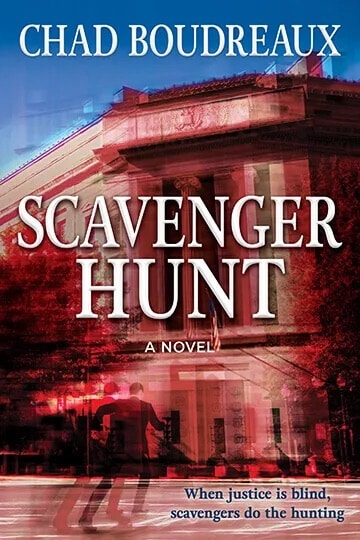
Yeah, so Scavenger Hunt, which is my, um, my first book, took me, uh, 18 months to write over 20 years and, um, finally got published. And, um, and then after that, it takes about 9 months to write the books after that. I’ve written Homecoming Queen, which is off-brand. It’s a love song to my hometown, a thriller to be sure, but not in the Scavenger Hunt series. And then Mob Justice is the second in the Scavenger Hunt series. And then The fourth one will be out probably at the end of this year or next year.
[00:03:59.260] – Alan Petersen
In Mob Justice, you’re tackling the Chicago mob, which, you know, I always think of it from the old days, you know, Al Capone and all that. So can you tell us a little bit about this? Tell us a little bit about Mob Justice, what it’s about, and because it’s set in the modern times, you know, of the Chicago mob. So can you tell us a little bit about that, about the origin stories?
[00:04:20.690] – Chad Boudreaux
Again, a Scavenger Hunt series. So for those that have read Scavenger Hunt, Blake Hudson is the protagonist. And spoiler alert, he survives the first book and he gets into a little trouble in the first book. And so in the second book, we see him getting shifted to another assignment within the Department of Justice from terrorism to organized crime. And the organized crime task force was within the Justice Department, the first task force that was ever created to tackle organized crime. And my mentor when I was at DOJ was one of the charter members of that, and he used to tell me stories about what they would do. And so I got this idea that I would recreate the Chicago Mafia. There are really two factions within the Chicago Mafia, the Chicago Outfit, which was Capone’s gang, and then there’s also the North Side Gang, which is more of the Irish Catholic side. And so I revitalized both of those gangs. I think the Chicago Outfit still exists, and they’re not done an injustice in the book. But anyway, they are definitely alive and well. So we bring them back, and it’s It’s the backdrop for the story.
[00:05:45.410] – Alan Petersen
I mean, like I said, the Chicago Mafia has such a dark, iconic history. How did you make it feel modern and grounded in today’s reality of what’s going on nowadays?
[00:05:54.690] – Chad Boudreaux
You know, there’s nothing new under the sun, right? So, you know, it’s one of those things where I did a lot of research and I spent a lot of time in Chicago, and I found that what held true back in the day is largely the same now. You know, obviously they dealt with Prohibition back then and they thrived under Prohibition. but there’s some great things that come out of that. So there are in Chicago underground tunnels, not the Pedway, but underground tunnels that most people don’t even know exist. And they are 40 feet underground, and they used to be used to peddle hooch, booze, by the gangs throughout the city. They still exist. They’re closed down, but we bring those back into the book. There’s a lot of stuff that you know, you think has gone away that is still kind of there. And so it’s very easy to, I guess, give that some breath and, and to make it a great story, hopefully.
[00:06:54.170] – Alan Petersen
And for listeners who are new to the series and not familiar, can you tell us a little bit about Blake Hudson? And I know he’s a Department of Justice and you were at the Department of Justice. So I have to ask, is he based on you? Can you tell us a little bit about that?
[00:07:06.180] – Chad Boudreaux
So he’s, he’s definitely not me, but he is a young lawyer that, you know, started at the Department of Justice. Working for the Attorney General of the United States at an early age and kind of gets caught up in some things that are a little bit over his head. But he’s got a great personality and a lot of tools in his toolkit. So he is part of a clandestine group that in Scavenger Hunt is really comprised of all sorts of different disciplines and agencies around the government. So Delta Force, CIA ground branch, the Normal Suspects, and then he’s kind of the lawyer for that group. And what they were tasked to do was to kind of overcome some bureaucratic hurdles to stop terrorist attacks. Coming through that, now he is again, like I said before, he is reassigned to organized crime. And here he teams up with a new cast of characters, and it’s kind of the same Blake Hudson. He loves his country and wants to do best by his job and then gets caught up in something well over his head. And then we kind of see what happens after that.
[00:08:19.410] – Alan Petersen
Sounds like Chicago plays a pretty big role, like a protagonist of sorts, the city of Chicago.
[00:08:26.520] – Chad Boudreaux
Yeah. So I mean, I try to personify everything that’s relevant. And Chicago is very heavy in this book. And again, I told you, I spent a lot of time there. I’m a chief legal officer of a Fortune 500 company, and I don’t do things that are going to frustrate that.
[00:08:43.360] – Alan Petersen
But I did get a little bit of trouble when I was in Chicago.
[00:08:46.950] – Chad Boudreaux
They don’t like, they don’t like dudes taking pictures in certain places. And some of the events are some of the places that I visited, you know, I was there with my camera, which, you know, pretty much my phone, and there was a lot of people uneasy about that. So there was some, Chad, you need to get out of here. It was a lot of fun doing research for this book was a lot of fun, not only in terms of the city of Chicago, but just the rich history of the Chicago Mafia, because that is It’s really rich from Capone, but Capone just gets it started. I mean, if you ever go to the Chop House, which is one of the restaurants that’s featured in my book, they have a wall and the wall has all the gangsters, including Tommy Gun on the wall, and then all of the mayors and police officers that try to bring down the mobsters. It’s that one place where you really get a sense of how rich that history was.
[00:09:42.760] – Alan Petersen
As I was reading about when I was reading the first couple of chapters with Renzi. Tell us about that. It sounds like a fascinating character. He’s polished but morally complex, to say the least. Can you tell us a little bit about that and the importance that you put to those type of characters in your books?
[00:09:58.560] – Chad Boudreaux
Yeah, so just the legal industry in and of itself has changed so much over the last 20 or 30 years. And so I’m an in-house counsel. That means I represent one company and I’m the chief legal officer of that one company. My company happens to build warships, which is pretty cool. But there are other types of lawyers. There are law firm lawyers. There are, you know, there are wills and estates lawyers. There are criminal lawyers. There are all sorts of different kinds. But for the in-house community, those that work for corporations, we have really tried to, over the years, move to what we call the consigliere model. And what that means is we go from being a department of no. So the client calls you, can I do this? Yes or no? And the answer may be yes. The answer may be no. To being embedded in the business. When you’re embedded in the business, then you don’t really have to say yes or no. You’re there from the very beginning. So you can tell them, you can do this path, you really can’t do this path. And that has become paramount in our industry.
[00:11:01.950]
And I say consigliere because that’s based on The Godfather model of Tom Hagen, which is Robert Duvall’s character. And we lost Robert Duvall yesterday, who for me was the best actor ever. I mean, he had Lonesome Dove, you know, Augustus McCrae. He was Lieutenant Colonel Kilgore in Apocalypse Now, but he also was the consigliere in Godfather. And in that role, you kind of see how the mob lawyer works with the business, the client, to take care of problems. And, and so we all, those of us who I think are want to be good at our jobs as chief legal officers, we say we want to adopt that consigliere model. And Tom Hagen from Godfather is kind of a pretty good picture of that. I mean, we don’t, we don’t saw off horses’ heads and put them in beds like he did. Hopefully not. But, but we’re embedded in the business. We’re relied upon to solve the biggest problems. And so it’s the same thing with Enzo Renzi. He was a Supreme Court clerk like Blake Hudson, and he chose a darker path, and that path puts him in line to serve his client, who happens to be the Chicago Outfit, Capone’s group.
[00:12:20.770]
And along the way, he has to deal with Blake Hudson, who had clerked at a different time than he did. But they’re both extremely smart and have all sorts of different tools to solve big problems. And they come into conflict with one another. And it’s part of the beauty of the book, I think.
[00:12:39.280] – Alan Petersen
And so you mentioned this is a part of the Scavenger Hunt series. This is the second book. So how has Blake evolved then from book 1 and book 2? And for you, for writing the second book, how is that? Are you enjoying writing a series? Can you tell us a little bit about that?
[00:12:52.190] – Chad Boudreaux
Yeah, so I’ll start with the last question. So when I started Scavenger Hunt, I had about 10 ideas in my head that I wanted to write. And my second book was— I said it was off-brand earlier. That was a book that was really a love song to my hometown. I grew up in Corpus Christi, Texas, which I think is one of the most fascinating places on Earth. I wrote a thriller about that. And while I was writing that book, Scavenger Hunt had started to get some publicity. And I started hearing people say, we need another Scavenger Hunt. And at that time, I thought about all the ideas in my head, and they really were kind of all Scavenger Hunt-like books that I would write. And so I decided I would make it a series. And I’m glad I did because it really gives focus to kind of the trajectory of where I want to go with my writing. But Blake Hudson is, you know, a, like I said before, a very equipped young man who has a lot of skills and hopefully a great personality. But he’ll surprise you a lot. But I put him in situations where he doesn’t need to be, and I want to see how he gets out of those situations.
[00:14:05.420]
And just like if you have, you know, Jack Ryan for Tom Clancy or you know, the Gray Man or whatever, it’s, it’s kind of the same thing. You create a character that you think will appeal to your readers and that you like, and you give them some skills and some talents. You give them weaknesses as well. And then you put them in extreme environments where you kind of yourself try to figure out how they’re going to get out of it. And so Blake has evolved, I think, as a a neophyte lawyer at the Department of Justice. He’s now learning his way and gaining some wisdom along the way about how the real world works.
[00:14:46.940] – Alan Petersen
I was kind of curious too, because obviously you know that world very well, the legal world. But you’re writing fiction, so you’re trying to entertain people in these fast-paced thrillers. How does that balance that? Because you have your legal mind, but you need to entertain. How does that— how do you handle that?
[00:15:04.730] – Chad Boudreaux
So the way I think about it is I use my legal skills and talents to kind of undergird what I’m writing. So, you know, there are great stories even today. There’s real-world stories that are great coming out of the Department of Justice or otherwise. It doesn’t matter what your politics are. They’re just great stories and they deal with some really exciting things. And so it’s not hard to put a character like Blake Hudson into that environment and then create a story around it. I don’t spend a whole lot of time on— I definitely don’t spend any time on bringing my political view to my books. I give a balanced view to the reader. They can see kind of what happens behind the scenes and can make their own decisions on their own politics. That’s not for me to decide. I think having a good understanding of the environment in which you’re writing is crucial. So there are, there are 75% of the things I write about I’ve lived in some form or fashion, not the story itself, but the underpinnings of what I’m doing. So I know how terrorism task force work. I know kind of how lawyers operate within the department.
[00:16:16.810]
There are things that I’ve never done before that I go outside of my area to experts that know better than me. So for instance, in mob justice, there with organized crime, there’s a lot of wiretapping, and I’ve never done wiretapping. And so I went to the expert at the FBI on wiretapping, and I shared with him what I wanted to write. And like many other instances, they’re so, so helpful to, to provide support and, and tell you kind of like, that’s not the lingo we use. This is the lingo we use. And actually, that’s not how it works. This is how it works. And they’ll walk you through chapter and verse That’s kind of how it works. And so when you’re done with your book and you have the experts that are weighing in on it, whether it’s legal, intelligence, or law enforcement, you know that it’s going to hold up and it’s going to be correct. And then it’s just about kind of the publishing world and the marketing world after that.
[00:17:14.920] – Alan Petersen
Yeah, kind of curious too, because since you were within the DOJ, is that— could you just— you don’t have to— they don’t have to check anything or give you permission? You’re free to write these stories?
[00:17:26.810] – Chad Boudreaux
So for Scavenger Hunt, I probably didn’t need to get sign-off, but I did. I went through that process. I was also working at the Department of Homeland Security. I was the deputy chief of staff at the time, not a legal position, but a pretty high-ranking position there. And I gave Scavenger Hunt to them just out of an abundance of caution. But I don’t write about anything classified. And anything that I write that you see is something that may be based loosely on something that I’ve seen, but it’s never, certainly never based on any classified information. So at this point, being 20 years removed from the Department of Justice and DHS, I don’t have any classified intel in my head that could make it into the pages.
[00:18:11.490] – Alan Petersen
With writing a series, so you have to balance rewarding returning readers while still making it accessible to newcomers. How do you handle that? Like, can somebody who hasn’t read the first one, can they start with the second book?
[00:18:24.960] – Chad Boudreaux
Absolutely. So there’s a light touch at the beginning and we kind of introduce the characters and you get a full picture of who Blake Hudson is. And there are other cast of characters as well. But there are some references to Scavenger Hunt and why he is in the situation that he’s in. And I think that gives the reader enough to, to understand kind of what happened in the past and what’s going to happen moving forward as they, as they read through it. So I don’t spend a whole lot of time regurgitating what happened in the past. I don’t, I don’t think readers need that. But yeah, so the, the people that follow the series from cradle to grave will always feel like they know what’s going on. The people who show up on day one and read Mob Justice and never read Scavenger Hunt, they’ll have the book in, they’ll have a full book, you know, within the purview of everything they need to know to understand the story, and it’ll be fine.
[00:19:25.160] – Alan Petersen
You’ve mentioned before you did a lot of research on Chicago and you reached out to the wiretapping experts. So how much research do you put into these books before you actually start writing them? Can you tell us a little bit about that process?
[00:19:40.630] – Chad Boudreaux
Sure. So it kind of depends. So in the terrorism world, I didn’t know anything about Delta Force and how they worked or CIA ground branch and how they worked. So I did a lot of research myself on, on those particular areas, which are fascinating. And, and then also because of my job, I had people that worked for those agencies or divisions, whatever you want to call them. And so I was able to speak with people who actually knew ground truth of how things work. So that was good. For Chicago and the mafia, I don’t know anybody that is in the mafia, but I, you know, did a lot of research, read a lot of books, watched a lot of movies. I watched all the mob movies, so I didn’t try to overdo it. But those that are mob lovers will find several references that are not very open and overt. You have to know your stuff. It’s not crucial to the book, but there will be certain things that you’ll pick up if you read Mob Justice, if you’re a mob lover, based upon all the movie history. And then I just spent time on the ground talking to people in Chicago.
[00:20:56.260]
And again, I got kicked out of City Hall. I got kicked out of the main hospital there. I had a lot of fun doing the research on Mob Justice. Yeah.
[00:21:05.590] – Alan Petersen
What’s that process like? They just basically just say, please leave?
[00:21:12.330] – Chad Boudreaux
Interesting story. I love Pearl Jam and I was going to a Pearl Jam concert. They had back-to-back concerts. They had one on Thursday and one on Saturday. So I was going to go to City Hall because City Hall is really the only place you can get to the hidden tunnels I talked about. It used to be there were several access points. Now there’s only one and only the maintenance crew can get down because they had a big flood. We call it the big Chicago flood of 1991. But they had a big flood in Chicago in those tunnels, and City Hall is the only place where you can access them. So I needed to get my eyes on the elevator. I didn’t want— I knew I wasn’t going to go down into the tunnels. They weren’t going to let me do that. But I needed to see where the elevator was so my book could be real, because there’s a big scene in my book that where they take the elevators down to the tunnel. I ended up playing golf on Friday instead of going to City Hall. And so before I went to my second Pearl Jam concert on Saturday, I went to City Hall and it was closed except for one area.
[00:22:15.070]
City Hall is open on Saturdays in Chicago for weddings. They have justices of the peace in the back door. And so I had on my Nobody Cares, Work Harder shirt, uh, on Saturday, and, uh I acted like I was a part of a wedding party and I went in with the wedding party. Of course, they were all in tuxes and dresses. And then I kind of skirted off. And when I got to the area that I needed to see, I had a security guard and she came up to me and she goes, what in the world do you think you’re doing? And I said, I just want to know where the tunnels are. And she goes, you’re not going to the tunnels. And I said, I know I’m not going to the tunnels, but I just want to know where the elevator is. And then she pointed Um, she pointed to the tunnels and then she pretty much perp walked me out of the city.
[00:23:03.160] – Alan Petersen
I see. She pointed to them before she kicked you out though. So that’s nice of her.
[00:23:06.140] – Chad Boudreaux
Yeah, I almost tipped her because it was great. Yeah.
[00:23:09.120] – Alan Petersen
Oh, so that’s cool. I think this is the first time I’ve had an author that’s a wedding crash for their research. So that’s pretty awesome. That’s dedication. So with regards to your writing process too, now, do you, are you an outliner or you do all this research? Do you outline? Can you tell us about your actual writing process?
[00:23:27.560] – Chad Boudreaux
Yeah, so I have a formula now. I want to write a book that’s 100,000 words. It doesn’t have to be, you know, I don’t have to hit that, but, you know, I’m aiming for 100,000 words and I want 50 chapters and each chapter, obviously, 2,000 words. I do an outline to begin my book process. My outline is like scaffolding on a new construction. It attempts to get you where you need to be, but it could change and it usually changes about chapter 20, 25. When my characters take over, my outline kind of gets flipped on its head. I, again, I, I create characters. And Stephen King said this, and I thought it was hocus pocus. That was kind of malarkey when I, when I heard him say it in his book On Writing. But he was like, you know, I, I create these characters and they, they turn my book upside down and I don’t know what they’re going to do. And obviously you’re in control of your writing. But I really agree with him. Like, it’s like I create characters and I put them in extreme situations in the first 20 or so chapters.
[00:24:32.100]
And then by chapter 25, they’re doing things or responding to things in different ways because they have to. It’s their character. And so that changes really the trajectory of the book. And so for each of the 3 books that I’ve written, and even in book 4 that I’m writing now, I’m seeing that happen. I’m about at chapter 20 now. In my fourth book, also a scavenger hunt series book. And I’m already seeing things that I did not predict happen, and it makes the story so much better, you know, 10 times out of 10. But it’s part of the outlining process. You try the best you can to begin, and then it just upends itself probably halfway through for me.
[00:25:11.070] – Alan Petersen
And what do you use to write your books? Do you use Word or something else?
[00:25:14.520] – Chad Boudreaux
Yeah, so I just use basic Microsoft Word.
[00:25:17.880] – Alan Petersen
You have a very demanding job, obviously, working for a chief legal person for the, for a corporate Fortune 500 company, and you’re writing these thrillers. Uh, how do you balance that? Uh, do you set out specific dates and times that you can write, or how’s that, how’s that look for you?
[00:25:34.340] – Chad Boudreaux
I’m a big believer that you need to write every day, and I don’t do that myself, but that’s my aim. So I try to get up early in the morning, I think 4:30, get some words on the page. And sometimes it’s 5 words, sometimes it’s 500 words. You know, on a Saturday it might be 5,000 words. It’s kind of a daily— I won’t say grind because I actually find writing is therapeutic for me. And that’s why I think I can do what I do because my job is very demanding. It really is like 7 days a week and a lot of hard stuff that we have to get done. I mean, my company basically builds stuff that protects freedom around the world and provides peace around the world. And so we have to make sure that we get that done first and foremost. But I don’t watch a whole lot of Netflix. I do. I do watch some TV. I like sports, but I don’t binge watch. I get very— I get very discouraged when I spend too much time watching TV. I am very encouraged when I actually do something productive. And for me, writing is productive.
[00:26:43.320] – Alan Petersen
What do your colleagues think? Do they know about your books, about your, your writing career?
[00:26:48.130] – Chad Boudreaux
Yeah, they kind of— everybody asks the same thing. It’s like, how do you do it with your job? And, um, you know, it’s, it’s a discipline thing. Writing is discipline. I’m not the most disciplined person in the world. There are people that, including in my industry, that are very much more disciplined than me. But for whatever reason, this is something where I’ve— I can, I can be disciplined and, and get done what I need to get done. I I’m on a schedule that is my own schedule, and so I don’t have like a traditional publisher that’s going to tell me I have to be done by this date. But like I said, I’m pretty much a 9-month guy. It takes me 9 months to write a book, and then the hard work begins after that.
[00:27:26.670] – Alan Petersen
Yeah, that’s so— I always find that so fascinating, you know, somebody with your background and your career that you’ve had as an attorney, and then everyone like, oh, you write books? And then that’s like the one that’s, oh, they’re so intrigued. How do you do it? I always find that so funny.
[00:27:42.250] – Chad Boudreaux
Well, you know, you think it’s funny and it is, but that’s the greatest thing I love about writing books. Everybody asks me like, you know, how do you do it and all that. But so I’ll take myself out of it. I’ve been able to work with some of the best lawyers in the world and they are amazing at what they do. Like they have skill sets that I would dream to have. I mean, many of them, you know, are on the Supreme Court or clerked for a Supreme Court justice. And they are the top of their game and just a different level. It’s almost like a Ferrari at full scale. And, but they don’t want to talk about the law when they’re around me. They want to talk about the books. It’s like, hey, how did you, how’d you do that? Like, and how did you write that? So that’s, that’s been a lot of fun because I love talking about my job. I have a great job. Uh, many of us, many of us do. The people in my industry, whether it’s law enforcement, legal, intelligence, what have you, they often just want to talk about like, when’s the next book coming out?
[00:28:41.440]
I like the first one, the second one. It was— so it’s, it’s been very rewarding.
[00:28:45.440] – Alan Petersen
And you mentioned that you are working now on the third one, and that might be coming out, uh, later this year.
[00:28:50.800] – Chad Boudreaux
Yeah. So, um, I’ll be open and honest with your audience. I, I really want to, uh, and I think I have the ability to, um, say this with, with humility, kind of take over the Department of Justice space. The Department of Justice is very politicized now, rightly or wrongly. Again, I’m not getting into the politics of it, but they handle just a wide swath of so many issues. And you think about the lawyers for all the agencies. And so they get licensed to speak to everything. And if you read Tom Clancy, he’s DOD. If you read Ludlum, he’s largely CIA and State. And there’s each, each author kind of has his or her own agency that they’ve taken over. I haven’t really seen anybody that’s taken over the DOJ space. And so I really want to do that. And so through Blake Hudson and some other characters, that’s my path. And I believe that I was trained by the deans of the Department of Justice. I’ve dedicated my book to David Margolis, who was the cleaner at the Department of Justice. For 40 years. And I’ve got a character there. And I, and I worked there.
[00:30:02.140]
And I’ve been throughout the building and, and lived that life. And so the characters are not me, but I really do think I can get in that space and take it over. So that’s, that’s my, that’s my, that’s my goal.
[00:30:16.100] – Alan Petersen
Cool. That’s one of the largest departments, isn’t it, in the government?
[00:30:19.220] – Chad Boudreaux
Yeah, it is.
[00:30:20.340] – Alan Petersen
Yeah. All right, Chad. Well, that’s, that’s fascinating. And The final question I always ask my guests, because I have aspiring writers that listen to this, any advice, especially if they have a busy job like you do?
[00:30:31.670] – Chad Boudreaux
My dedication to my first book was from my mom, or to my mom. And, you know, she passed away in 2013 at a young age. She had me at a young age. And then when I was really young, she had me when she was 19, and we were totally broke. She would tell me like, never, never, never give up. Like the Churchillian cadence, never, never, never give up. And that’s what I would tell all aspiring authors. It’s hard. Like, it’s, it’s really hard to get an agent. It’s really hard to get published. Some people do it easier than others, but it’s a grind. And what I would tell people is it’s not just a rite of passage. It’s not just like going to Hollywood and, you know, you have to go through the motions. It’s getting better at your craft. Like, any time somebody tells you no, you go back and you make your craft better, you write better. And that’s why it took me 18 months over 20 years, because I thought, always thought I was paid to be a legal writer. I was paid handsomely for that. I could write a legal brief as good as probably most people.
[00:31:37.490]
I couldn’t write a novel as good as most people. And it took me that long to learn how to do it. And so there is a learning curve and most of us don’t really have the humility to understand that until it’s too late. But stay with it. If you stay with it and you are inspired by what you’re doing and that you are committed to what you’re doing, you will get better and eventually it’ll pay off. And I would tell everybody, no matter how long it takes, it’s worth it because it’s, it’s a really good on the side.
[00:32:07.700] – Alan Petersen
All right, great. So finally, Chad, where can the listeners find you online to follow your work?
[00:32:13.720] – Chad Boudreaux
Yeah, so I’ve— it’s very simple. It’s my name. It’s www.ChadBoudreaux.com. So Chad b-o-u-d-r-e-a-u-x.com.
[00:32:24.950] – Alan Petersen
All right, so Mob Justice comes out March 17th. Chad, thanks so much for coming on the podcast.
[00:32:30.070] – Chad Boudreaux
I really appreciate you having me on. It’s been great.
[00:32:36.050] – Announcer
Thanks for listening to Meet the Thriller Author hosted by Alan Peterson. If you enjoyed this episode, be sure to subscribe and leave a review on your favorite podcast platform. It helps other thriller fans discover the show. You can find all past episodes, show notes, and author interviews at ThrillerAuthors.com, including conversations with icons like Dean Koontz, Freida McFadden, and Lee Child. And if you’re looking for your next gripping read, check out Alan’s own psychological thrillers and crime fiction novels at ThrillingReads.com/books. Until next time, stay safe, keep reading, and keep the thrills coming.